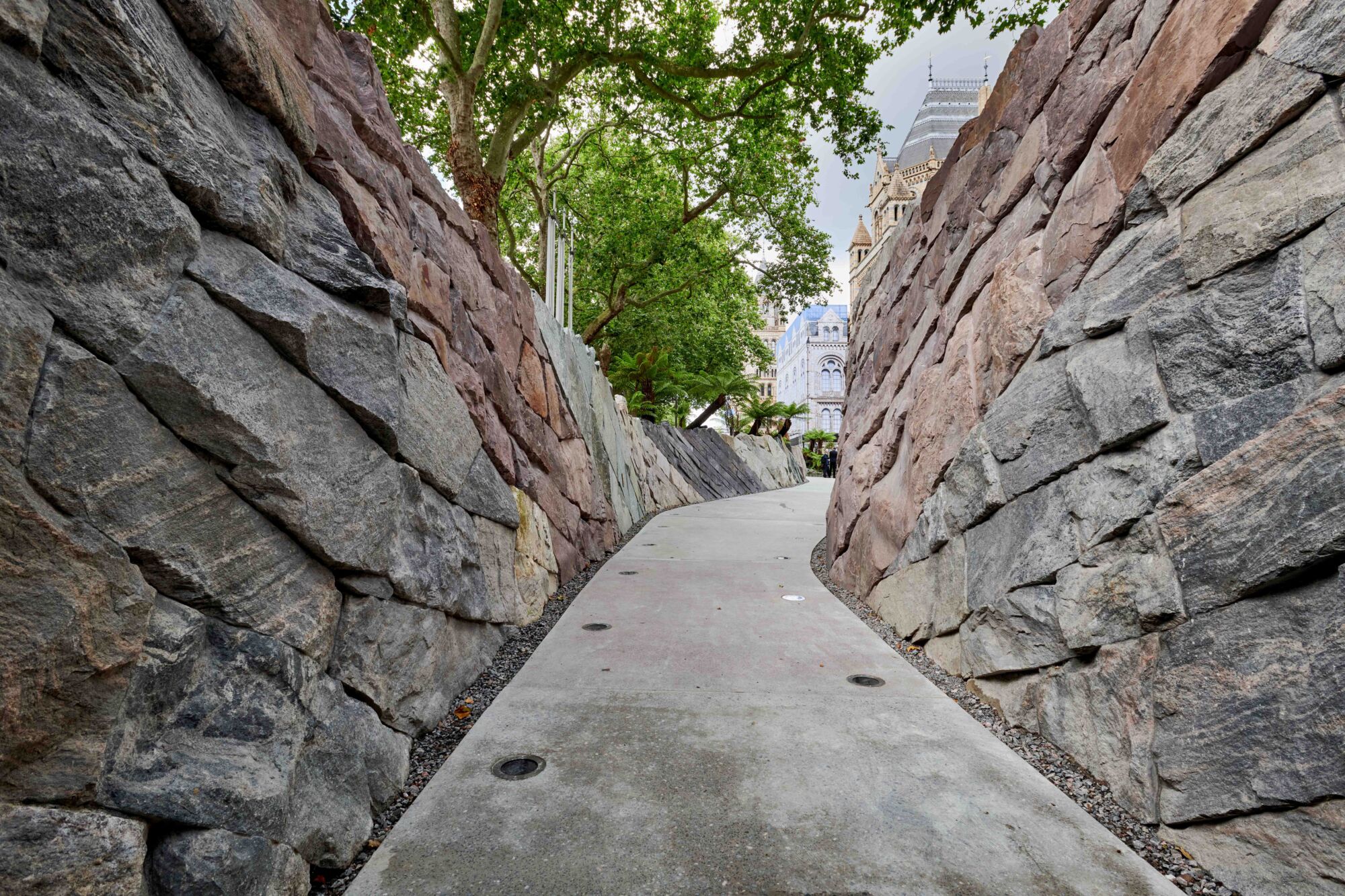
Urban Nature Project, Natural History Museum
Client: Natural History Museum
Principal Contractor: Walter Lilly
Architect: Fielden Fowles
Package Value: £2M
The Natural History Museum’s transformed gardens were opened to the public in July 2024, following a five-year redevelopment plan, formed of the Nature Discovery Garden supported by the Cadogan Charity and the Evolution Garden. Architects Feilden Fowles led the transformation of the gardens, collaborating closely with Museum experts and landscape architects J & L Gibbons. The project has transformed the visitor experience on arrival at the museum.
Over in the Evolution Garden is the Evolution Timeline supported by the Evolution Education Trust – an immersive and tactile pathway through time featuring plants, geology and gleaming representations of reptiles, birds and mammals, reflecting the story of geology and evolution on Earth.
Szerelmey’s work formed an integral part of Evolution Timeline. Given around 2.7 billion years of geological history was being represented in the garden, it was never going to be a project without its complexities and challenges – not least in locating and sourcing the rocks.
Working closely with Museum scientists, the rocks are positioned to tell the story of the different geological ages of the planet. A stand-out feature of the timeline is the rock canyon wall which flanks the new entrance into the gardens from the South Kensington Underground subway. There is a nod to the Precambrian period within the rock canyon.
Then from the beginning of the Cambrian period c.540 million years ago to the present day, the timeline is scaled so that every metre represents 5 million years.
Each geological time period – including the Ordovician, Silurian, Devonian and Carboniferous periods – has at least one rock representative of it. Szerelemy selected and supplied, with help from CED Stone, many of these boulders and blocks from around the UK, which were then digitally recorded and laid out in sections before being precision cut to form the interlocking cladding as required by the design team.
Szerelmey’s work in the Museum’s gardens also included elements of the construction of two buildings and the landscape, creating a more accessible open space for the public with boulders and seating. They provided the stone cladding to the Nature Activity Centre supported by Amazon Web Services using the British stones Purbeck Spangle, Ancaster White and Clipsham. Additionally, Szerelmey supplied and installed large wet cast concrete coping and cladding units for the link corridor and Function room of the Garden Kitchen.
The geology of the walls within the Evolution Timeline were amongst the biggest challenge, not only in sourcing and locating the different stones many of which are not quarried any longer, but also in its construction.
Starting first with locating the stones, all but two were sourced from across the UK, with several coming from Scotland. The oldest stone on the project is called Lewisian gneiss and it is found in the furthest outreaches of northwestern Scotland and the Western Isles. The hunt for this and other stones involved planes, trains and automobiles and a tight team including specialist suppliers, contractors, a scientist from the Natural History Museum and the architect.
Following adventures on Barra, the team struck out by car from Oban to Inverness and around the Moray Firth in Scotland to visit several other disused quarries where they saw granites from the Ordovician and Silurian Periods, sandstones from the Triassic Period, and the striking pink Torridonian sandstone, also from the Precambrian of northwestern Scotland.
Other stones that make up the timeline walls are Cambrian Quartzite, the distinctive purplish Welsh Heather Slate, White Anorthosite, Greenschist, Grampian Granite, Cumbrian Slate, Nairn Park Granite, Old Red Sandstone, Northumberland Stone, Slabby Sandstone, Cornish Granite, Scoria Volcanic, Corncockle Sandstone and Lossiemouth Sandstone from the Spynie Quarry.
The Spynie Sandstone comes from Moray Firth. This stone is interesting because it formed in the Triassic Period (c. 201–252 million years ago) and was laid down in a desert dune system. It is hard to believe there were deserts in Scotland!
The Cornish granite in the walls and garden was sourced from Carnmenellis near Redruth, Cornwall. Another familiar stone for many is the iconic creamy-white Portland stone, from which many of London’s buildings are constructed. Pieces of Portland stone can be found in the Jurassic Garden area, which is one of the three periods when dinosaurs roamed the earth.
Another of the distinctive white stones to be found in the garden is chalk with some fossils and flint in it. Unlike most of the chalk rocks of southern England which are quite soft, this is a hard chalk sourced from Londonderry. Located at the end of the timeline walls are examples of Sarsen stones which are famous as Stonehenge’s outer ring of megaliths.